

Unlike the stereotypical Dutchman, Tahrim Ramdjan was not raised on a bike. His commute to secondary school – from multicultural De Bijlmer to the affluent Oud Zuid in Amsterdam – was by metro. And one day, as a troubled boy who had recently lost his father, he thought about jumping from the platform.
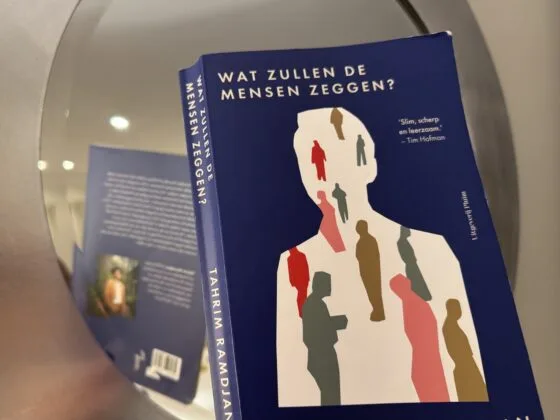
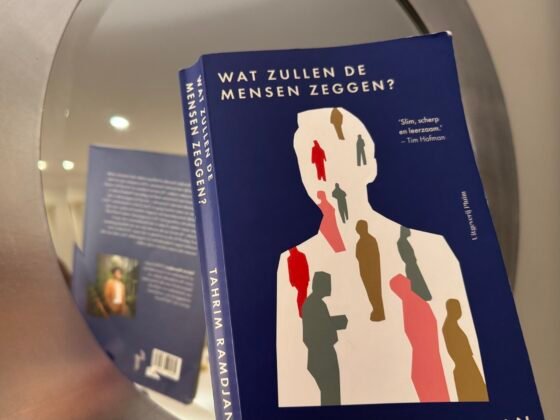
More than a decade later, Ramdjan is a reporter and chief opinion editor at Dutch newspaper Het Parool and has written a book – “What will people say” – about the contradictions of living in the Netherlands as a minority. He is gay, of Indo-Surinamese origin, one of few from his district to win a place at an elite “gymnasium” school, and brought up in a liberal Islamic household.
As well as a personal memoir, the book is a political protest about the contradictions of a liberal society that pigeonholes people, a country that values justice, yet put him on a tax office blacklist at 15, after his mother mistakenly overpaid her tax – and an official ticked a box to call it a sign of fraud.
“What do you need to do to be Dutch enough?” wonders Ramdjan at the start of his book, watching the far-right PVV win a quarter of the seats in parliament. “This is my goddamn country. And I’m not going away.”
Sitting in an old journalists’ haunt with its name stamped on the biscuits, 27-year-old Ramdjan prefers to see his book as a personal story about identity and belonging – although it is one that unflinchingly points out when the egalitarian self-image crumbles into nasty comments (from a teacher) that he should “go back to the apes in De Bijlmer”.
“I wrote it for my 13-year-old self…because I didn’t have something like this then,” he says. “So it’s a kind of roadmap. What does it mean to be me, with all these identities? And how do you navigate that?”
His ancestors were indentured labourers enticed to the Dutch colony of Suriname from India after the abolition of slavery – a group referred to in Dutch as “Hindustani Surinamese”. His well-educated parents emigrated to the Netherlands.
Gay, and one of a small ethnic minority at his rich, largely-white secondary school, he felt like the odd one out: the contrast between his homosexual identity, rice-eating family and pasta-eating friends became the basis for a long journalistic essay in 2020. Two publishers got in touch and the result is a book, five years later.
He recounts growing up in a liberal Muslim family where his dad died young, then his struggles to fit in, both in well-to-do society and a judgemental gay community. But, he says, speaking out about prejudice and racism is not universally applauded.
“It’s hard, because it’s not appreciated if you bring this up,” he says. “[The reluctance to be self-critical] is something that runs very deep with Dutch people.”
The book is full of references to books he has read, studies and data – he says – as an attempt to show the systematic failure. “We’re a very pragmatic country, and that has brought us a long way,” he says. “Public services are well organised…[but] the risk is that we then fail to have certain essential conversations.”
More than a decade ago, when protesters started the Kick Out Zwarte Piet movement to protest against racial caricatures and blacking up in the children’s Sinterklaas celebrations, the conversation was unwelcome. “People are quick to say: ‘Keep the atmosphere nice – what’s all the fuss?’ It gets trivialised, it gets relativised, and then you never get to the essential conversation.”
The KOZP group, recently disbanded, did make people have an uncomfortable conversation, says Ramdjan – but in other areas of life, prejudice is brushed over. “The thing [is] with racism in the Netherlands—also with landlord discrimination and Islamophobia—it’s all so subtle,” he says. “You get a remark, or a look, or you notice someone treats you differently. But you can’t quite put your finger on it…You can’t prove it.”
Dogmatism
Dogmatically seeing racism everywhere isn’t the right response, he says. “There are also people—this is the difficult part of this story—who see racism everywhere, who see disadvantage everywhere. I see it as a division between how you’re treated in daily life. Part of that is based on your personality, your skills, and norms and values. And part of it is those identity attributes you can’t change: colour, class, sexuality, religion, nationality.”
But he argues for fairness – and seeing each other as individuals rather than jumping to judgement. “Look at queen Máxima: she’s constantly criticised for her accent – the queen of our country,” he points out.
“Writing this book also felt like a duty. It’s easier to stick your head in the sand…There are people who act like it doesn’t exist. Or they don’t see their own colour. They suppress their sexuality. But I can’t.”
So writing about it is his reckoning – with homophobia, racism, Islamophobia, classism and prejudice against the neighbourhood where he grew up. “I’ve tried to adapt and assimilate to a dominant norm in my head, to the community in Oud Zuid, to the Hindustani community,” he says. “But I can’t. It doesn’t work. So this felt like something that had to happen – to make that space.”
Expat
Ironically, he also has a sense of how it is to be treated as an “expat” in the Netherlands, because he is often mistaken for one. And yet the thing that draws many people to the country, the much-marketed concept of tolerance, is an identity he hopes the next government will embrace.
“In 2019 I wrote an opinion piece…where I said: tolerance is one of the values we’ve known since the Enlightenment,” he says. “Why don’t you claim that as Dutch identity? I understand wanting a story of a collective Dutch identity. So take that as a starting point: that tolerance and forbearance are our strength, and that we look at everyone as human.”
Even if it is a Sisyphean struggle to ask people to have uncomfortable conversations, he believes, putting “the darkness into the light” makes it less intimidating and harder to ignore. “I wanted to show: I’m not seeing ghosts,” he says. “I’m not the only one who sees this. It exists…There’s a sense of calm – recognition – that you’re not alone in the experience.”
Now, reporting on his city with open eyes and ears as he cycles around, Ramdjan jumps on his bicycle – and is off.
Wat zullen de mensen zeggen was published in 2025